Internet Explorer
Internet Explorer is not supported. Please upgrade to a more modern browser.

When Kavdek was lost to the sea, the Nakam lived on. When the undead came to the Northern Kingdoms and ran them from their homes, the Nakam lived on. When the Daughter of Grief pierced the veil between worlds… the Nakam lived on.
Nakam & Ages
Nakam live for four ages.
Description
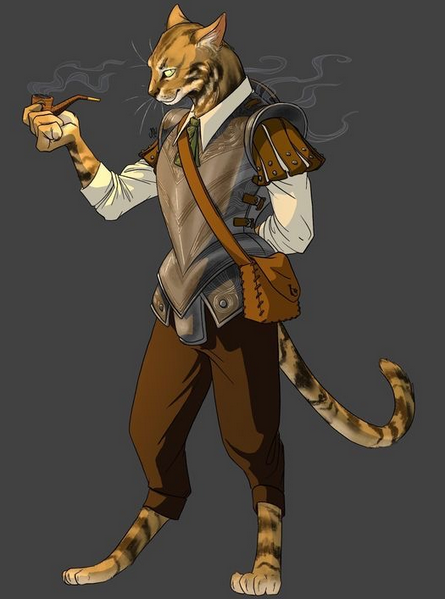
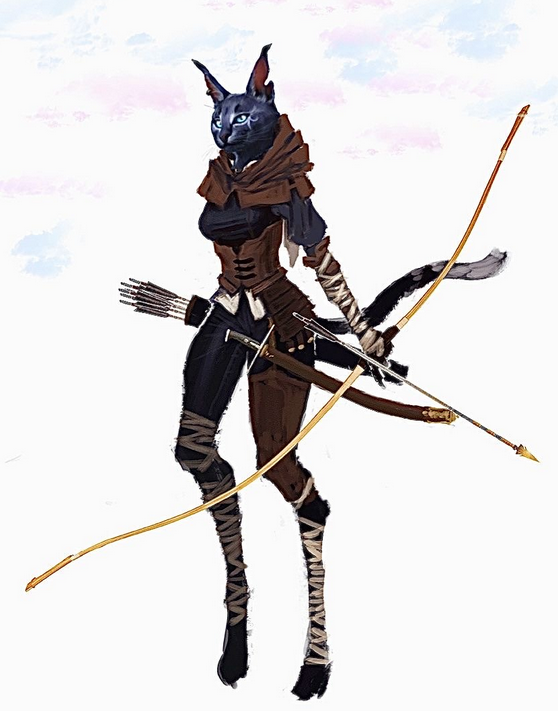
The Nakam are anthropomorphic cats. Nakam may be no shorter than 4’8, and no taller than 5’10. A Nakat’s head, tail, and digitigrade legs resemble that of a domestic cat. The rest of their body, though most are covered in fur, closely resembles a human form.
In terms of their appearance, Nakam represent the full spectrum of feline variation with their fur color corresponding to any pattern that could be found on a mundane house cat. Some Nakam are totally furless, though this is rarer than their furry counterparts, but in that case they have the loose and sensitive skin one would expect of a house cat and the full spectrum of those colors instead.
Their eyes are catlike, with slit pupils that reflect light in dark conditions. Nakam may have any eye color available to either humans or felines, from deepest blue to witchy yellow. Heterochromia is much more common among Nakam than other races.
Conservative Nakam have a lot of cultural taboos and beliefs about their whiskers. They spend a great deal of time grooming their whiskers and taking meticulous care of them, for in the old days a Nakat’s whiskers were believed to be a physical representation of their identity and social standing. To rip out their whispers or trim them very closely was seen as adopting a new identity or rejecting the social order: a brave act to some, a frightening subversion to others. In point of fact, the whiskers are just hair and Nakam who have less attachment to the roots of their culture often just treat them as such.
It should be noted that Nakam do not meow, hiss, or purr like cats. They can attempt to recreate the sounds, but it will sound as good as any other race. Likewise, Catnip has only a mild euphoric effect on Nakam. It did not grow upon their native lands, but it did become a curious discovery when populations spread out.
Nakam reach physical maturity at the age of eighteen, culturally at twenty. They share similar cycles & pregnancy lengths as humans. Once upon a time, Nakam could only give birth to one K’ub at a time. Now, twins are common. Their life expectancy is the same as humans. Nakam cannot procreate with other races.
Traditionally, a Nakat’s life would be divided into the following stages, progression from each being a cause for great celebration:
0-3 Dekdaki (the Beginning Age)
3-13 Dakichal (The Age of Innocence)
13-20 Dakibek (The Age of Idiocy)
20-45 Dajakal (The Age of Responsibility)
45-death Dakeva (The Age of Wisdom)
Abilities
Nakam have heightened vision, hearing, and sense of smell. This can be useful, but it can also be a disadvantage: bright lights, loud noises, and foul odors that would not bother another race can be debilitating for them.
Nakam can see well in darkness, so long as there is at least a small amount of light for their eyes to reflect.
History & Culture
The Nakam are originally from an island called Kavdek. Kavdek had an arctic climate being frozen year round, but far from being lifeless, the mountainous isle had ancient and sacred trees that were uniquely evolved for the cold climate. Easy to become lost between the interwoven wilderness, the Nakam were its guides. Verbali was its main city, and a large number of smaller Native settlements dotted the island.
Kavdek was discovered by outsiders, who were forced to trade with the Nakam on the Nakam’s terms. The culture at the time was extremely insular among the Nakam, and they rarely trusted outsiders. They welcomed no one into their ranks, and very few Nakam left Kavdek to explore the rest of the world.
There are a thousand different versions of why Kavdek sank beneath the waves, ranging from legend to scientific theory. When it drowned, most Nakam in the world drowned with it, leaving the race on uncertain footing with regards to outright extinction.
Thankfully, there were already colonies in the world outside of Kavdek at that time. The last known settlement of the Nakam was Kavdu, in the Northern Kingdoms. A small village on a snowy, misty island. When it fell to the undead during the great exodus from the Northern Kingdoms, the surviving population of Nakam split into several disparate communities that spread over the world. Some were insular, some friendly, some conservative, and so on.
Nakam are Animists. The belief that all entities — animals, plants, rocks, rivers, weather, fire, words, mortal creations, etc. — possess a spiritual essence or soul. The Ancestors, called Naklefam, are deeply venerated for their wisdom and their place here in life before them. In times past, it would have been inconceivable for Nakam to worship the Divines, as it would be anathema to elevate the gods of other races above their own ancestors, but your Nakat has likely had to compromise their cultural beliefs with the reality around them since the drowning of Kavdek.
While not gods, these four ancestors are generally the most venerated by traditionalist Nakam:
Sxoki, the first Farmer.
Bekku, the first Craftsman.
Sajek, the first Warrior.
Zerin, the first Mother.
With lack of worship to gods in mind, it is even less likely to find a Nakat bowing before another mortal. Most Nakam treat others as equals, whether they be friend or stranger. However, especially conservative Nakam likely still cling to the belief that their culture is too unique to ever integrate with others and hold all other races and peoples in contempt Among themselves, even conservative Nakam hold strong egalitarian beliefs. Leadership among Nakam groups tends to be split into a council, it is only under dire circumstances where one Nakat would make a decision for the rest of their people.
There was a time where all Nakam despised magic and those who used it. Uniquely among all other peoples at this early point in Alteran history, they believed that magic - whether arcane or divine it did not matter - used the souls of the dead as fuel. So magic became totally anathema to them, as it was thought to deprive their people of an afterlife. Some still cling to this belief.
Original concept by Valcust, preserved by Michcat, and modernized by Arcana.
 1
1